

SOLID Principles – Interview-Ready Guide
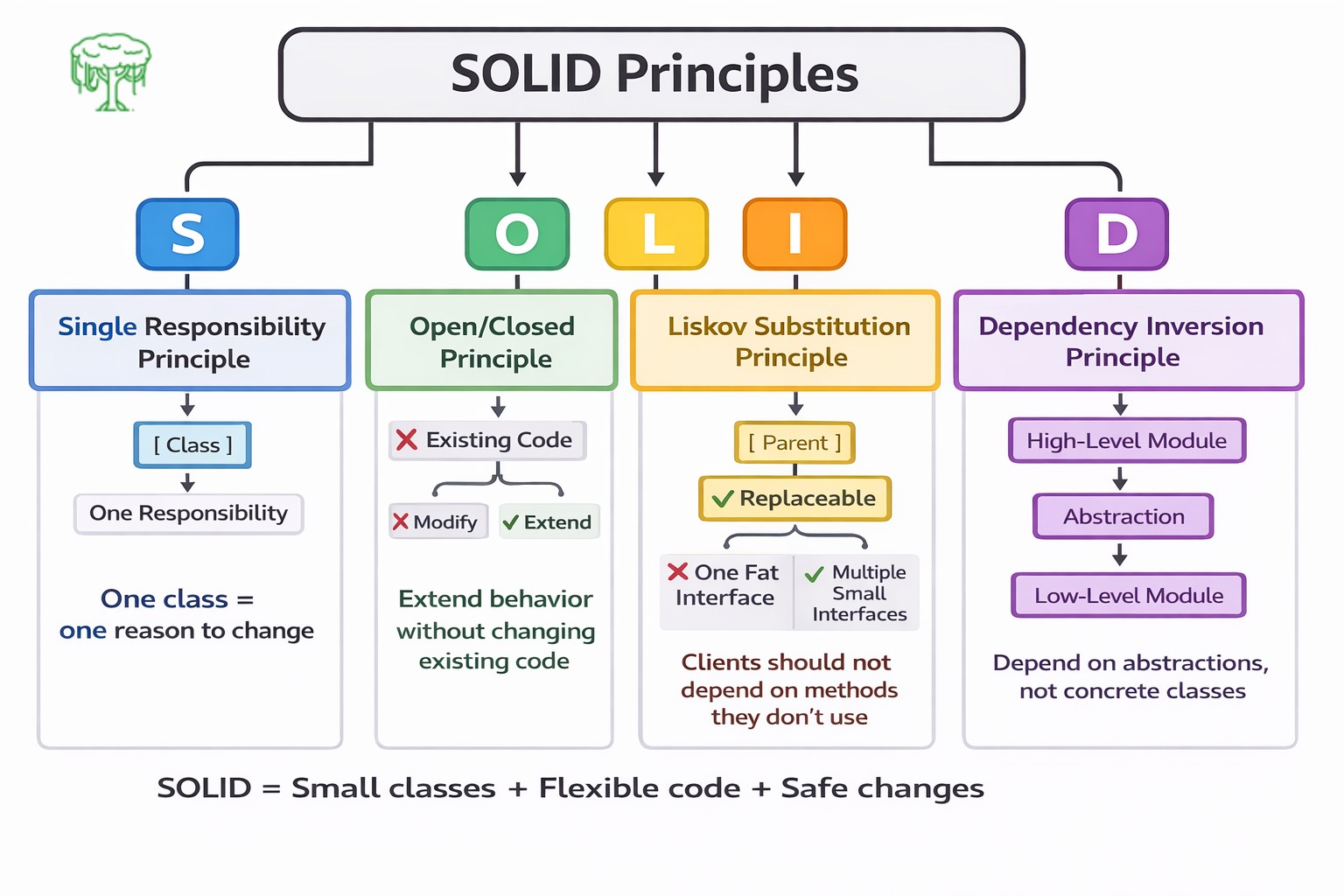
SOLID Principles are a set of five object-oriented design guidelines that help developers create clean, maintainable, and scalable software. They provide direction on how classes and modules should be structured so that code remains easy to understand and modify.
By following SOLID, changes can be made with minimal impact on existing functionality, improving flexibility and testability. Overall, these principles help reduce tight coupling and ensure long-term code quality.
✨ SOLID – Object-Oriented Design Principles
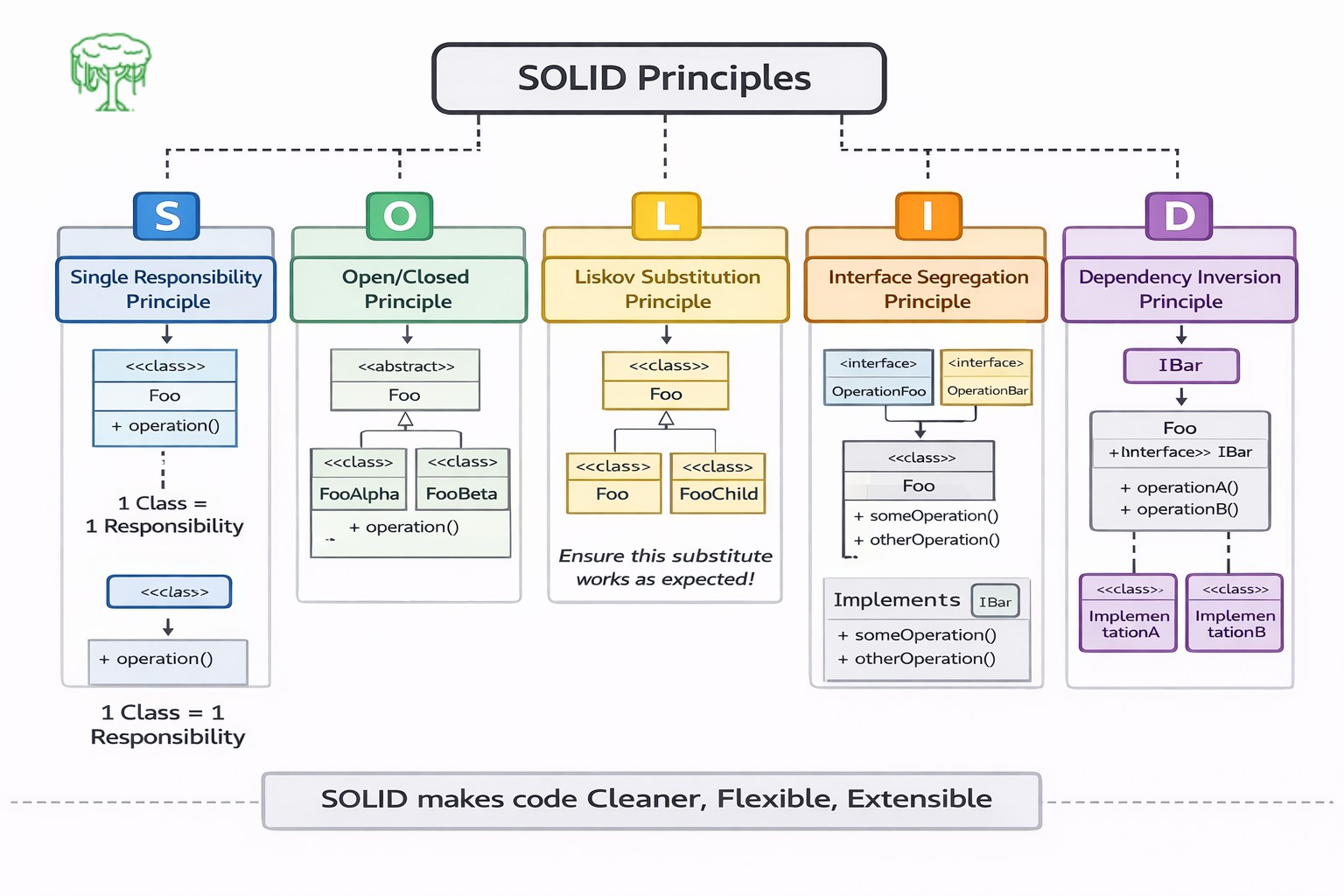
- S — Single Responsibility Principle
One class, one responsibility - O — Open/Closed Principle
Open for extension, closed for modification - L — Liskov Substitution Principle
Derived classes must be replaceable with base classes - I — Interface Segregation Principle
Many specific interfaces are better than one general interface - D — Dependency Inversion Principle
Depend on abstractions, not on concrete implementations
Crisp, Interview-Perfect One-Liners
S — Single Responsibility Principle (SRP)
➡ A class should have only one reason to change.
Analogy: 👨🍳 Restaurant Staff
- A chef cooks food
- A waiter serves food
- A cashier handles billing
Each person has one job.
➡ If the chef also starts billing customers, things break.
In code: One class = one responsibility.
O — Open/Closed Principle (OCP)
➡ Software entities should be open for extension but closed for modification.
Analogy: 🔌 Electric Switch & Appliances
- You can plug in a fan, TV, or charger
- You don’t change the switch every time you add a new device
➡ The system is open for extension, closed for modification.
In code: Add new behavior without changing existing code.
L — Liskov Substitution Principle (LSP)
➡ Derived classes must be replaceable for their base classes without breaking behavior.
Analogy: 🚗 Car Replacement
- You can replace a petrol car with an electric car
- Steering, brakes, and accelerator still work as expected
➡ The replacement shouldn’t break expectations.
In code: Child class should work anywhere parent class is used.
I — Interface Segregation Principle (ISP)
➡ Clients should not be forced to depend on interfaces they do not use.
Analogy: 🛠 Remote Controls
- TV remote has only TV buttons
- AC remote has only AC buttons
➡ No one likes unused buttons.
In code: Many small, specific interfaces are better than one big interface.
D — Dependency Inversion Principle (DIP)
➡ High-level modules should depend on abstractions, not on concrete implementations.
Analogy: 🔌 Charging Cable
- Your phone depends on USB standard, not a specific charger brand
- Any compatible charger works
➡ Depend on abstractions, not concrete implementations.
In code: High-level modules should not depend on low-level modules directly.
🔑 Ultra-Short Memory Version
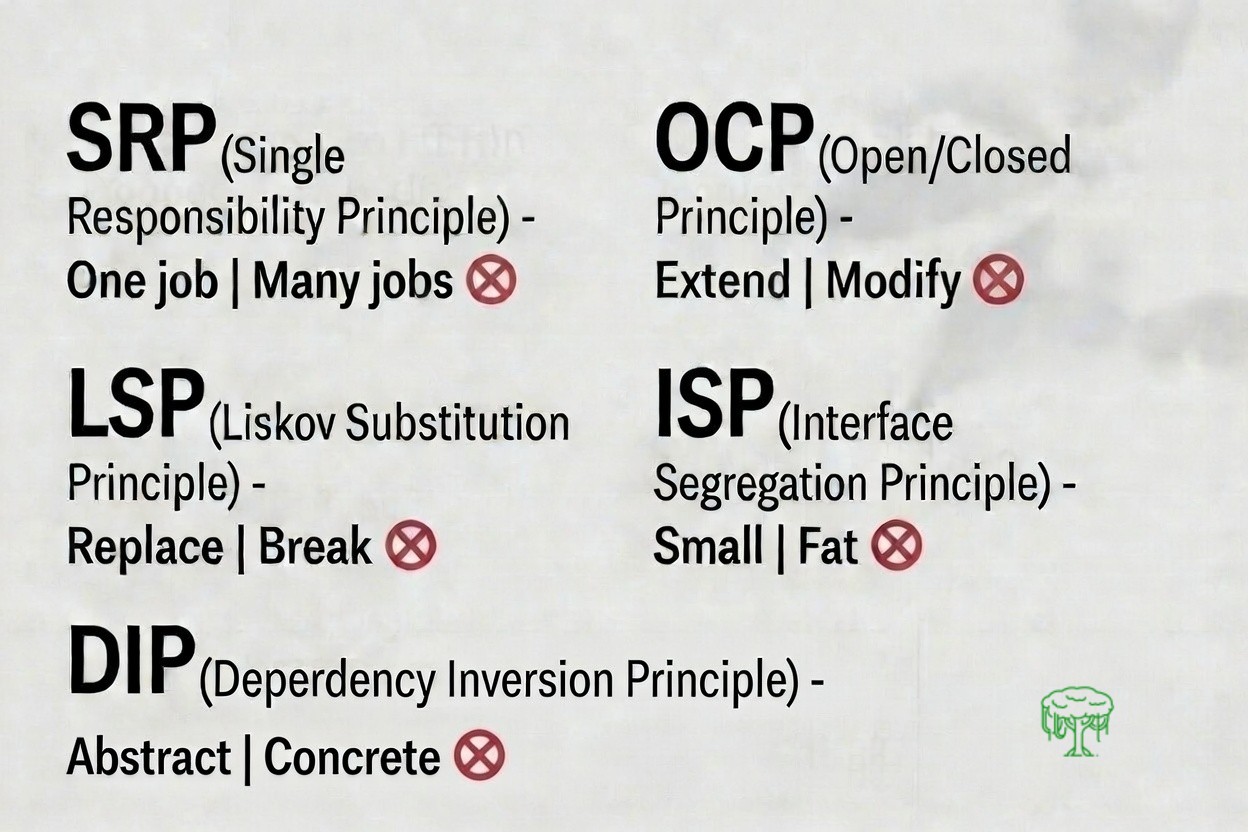
- SRP → One job | Many jobs ❌
- OCP → Extend | Modify ❌
- LSP → Replace | Break ❌
- ISP → Small | Fat ❌
- DIP → Abstract | Concrete ❌
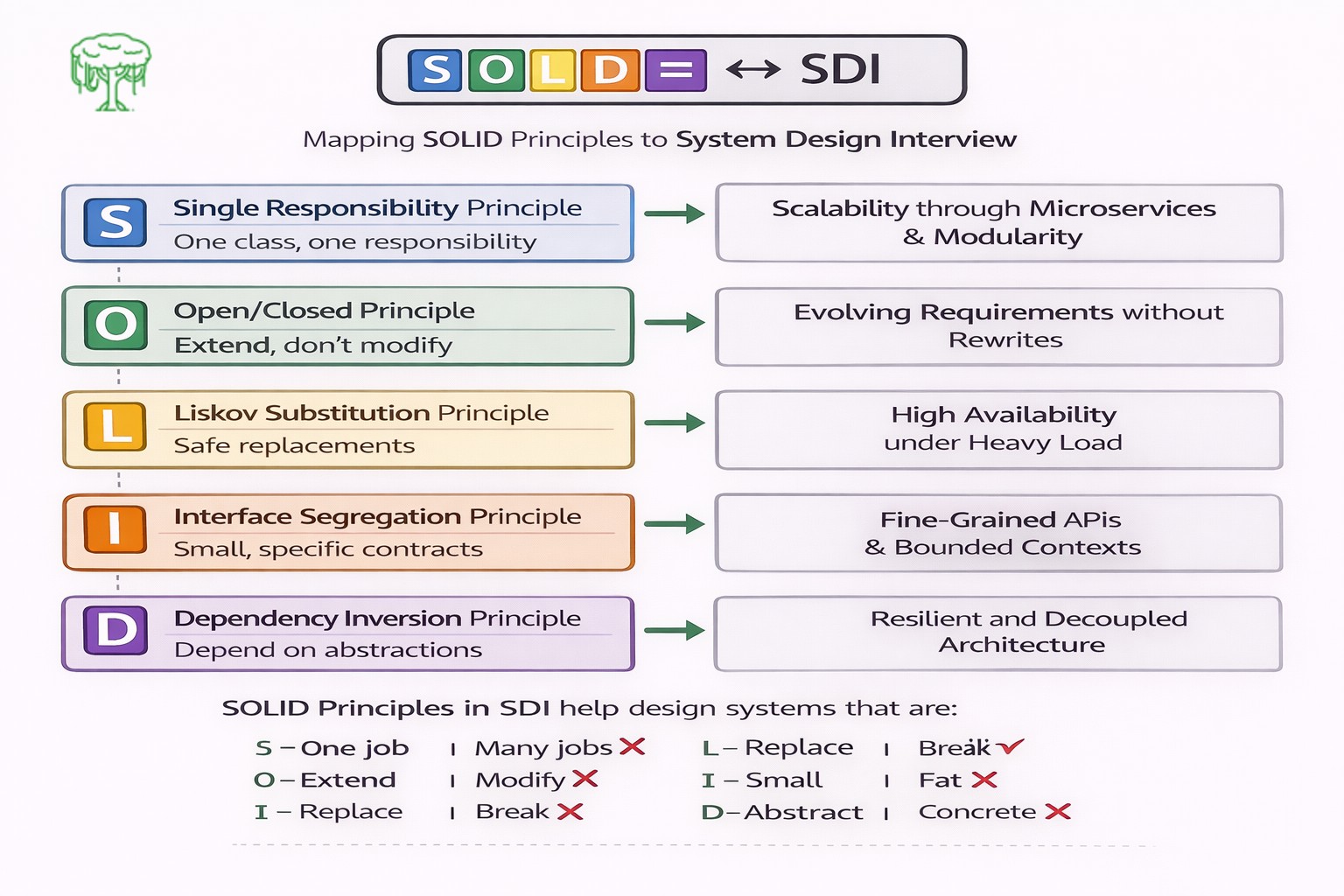
🖼 Brief Explanation of the Image
The image shows how SOLID principles map directly to System Design Interview (SDI) concepts.
- S → Modular services and clean separation of concerns
- O → Feature evolution without rewriting existing code
- L → Safe component replacement and reliability
- I → Fine-grained APIs and service boundaries
- D → Loosely coupled, resilient, testable architectures
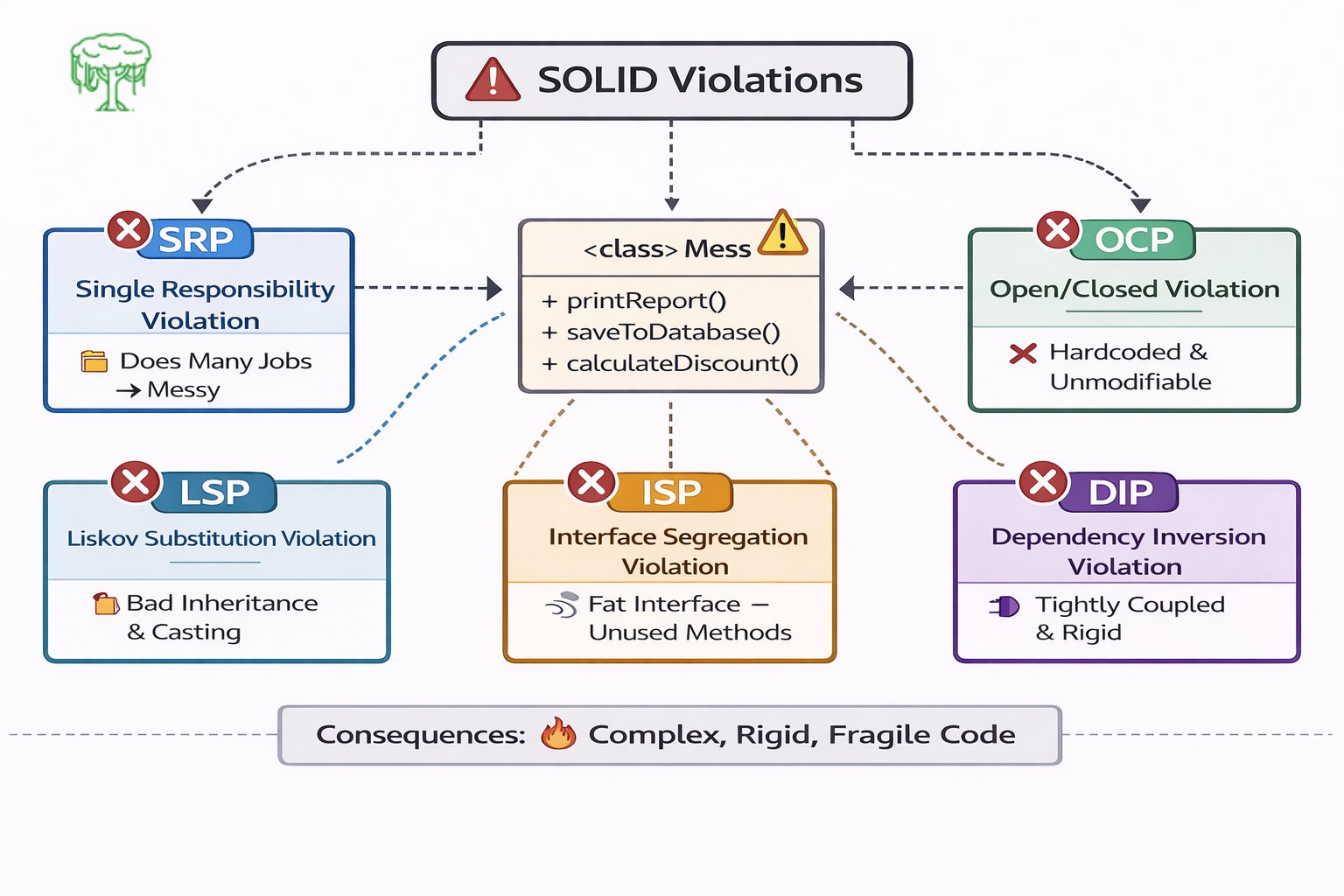
Master SOLID in Minutes with This Handy Cheat Sheet
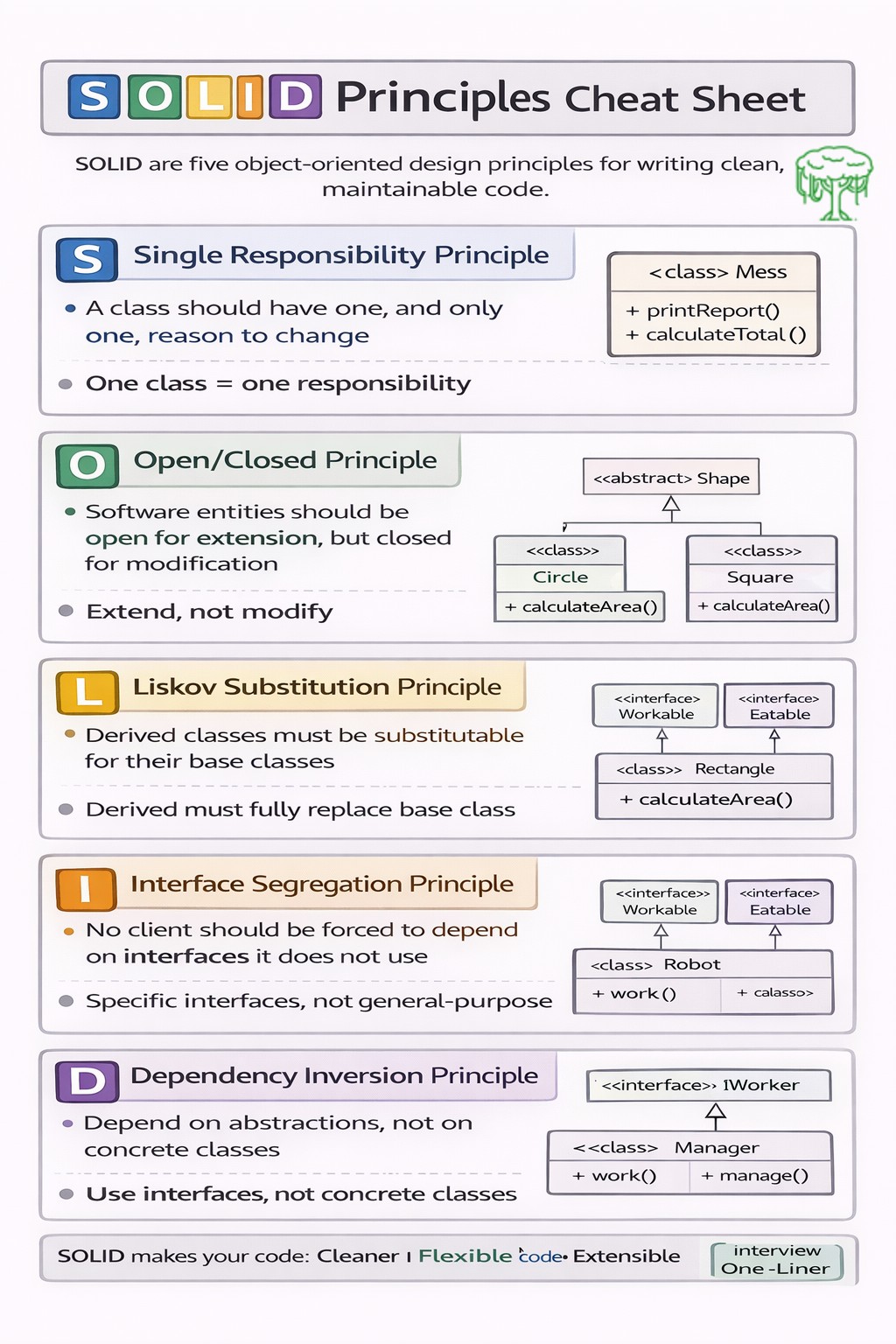
Overall message: SOLID leads to scalable, maintainable, flexible systems—exactly what interviewers expect in system design rounds.
In our upcoming articles, we will walk you through each SOLID principle in a clear and easy-to-understand manner, supported by practical code snippets. These explanations will strengthen your conceptual understanding and help you confidently prepare for real interview questions and system design discussions.